Every Life Matters.
So Does the Person Trying to Save It.
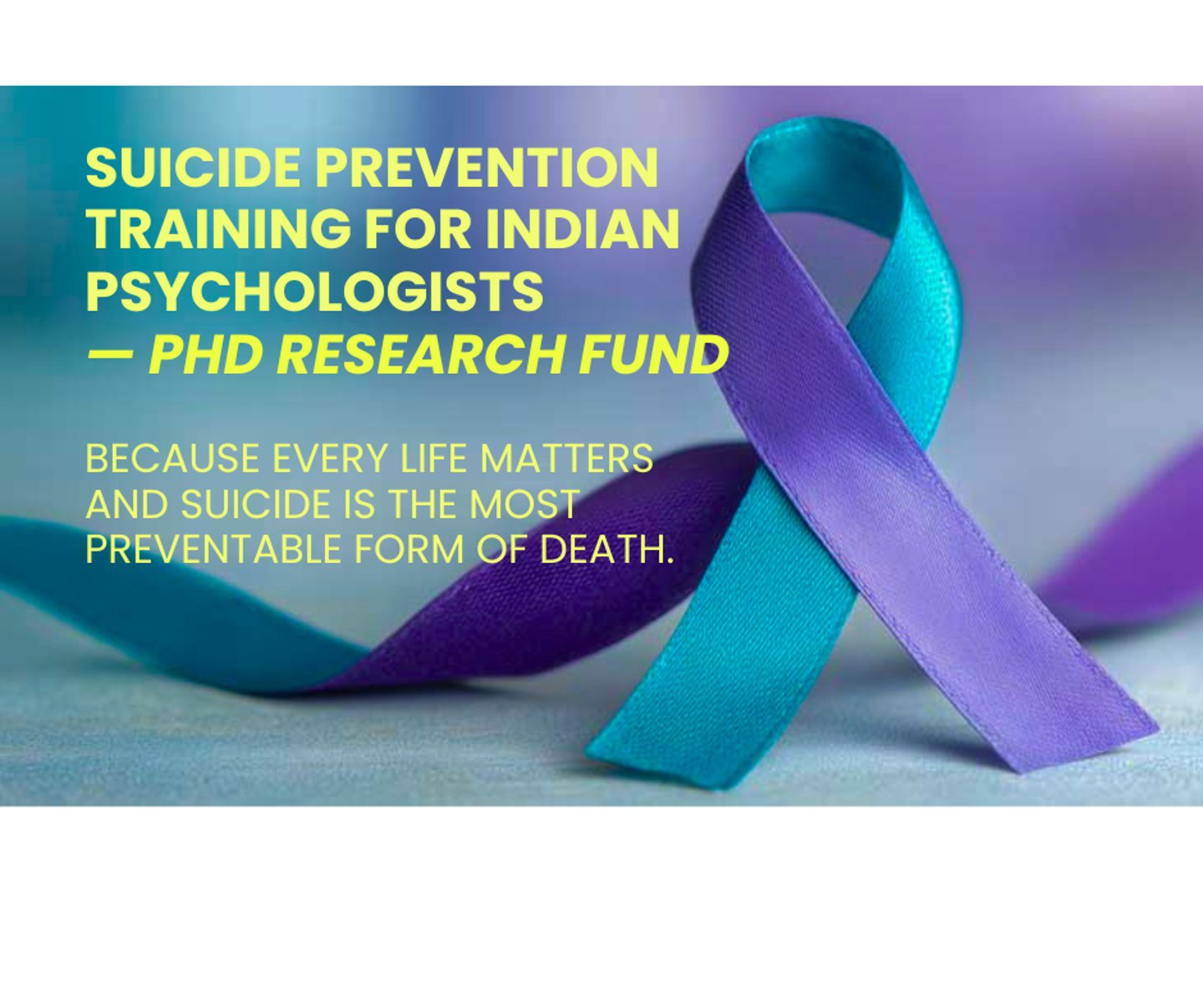

At Khejdi, we believe that meaningful mental health work is built on both compassionate practice and quality research.
Jyoti, a fellow mental health professional, is pursuing her PhD in Counselling Psychology with a focus on Suicidology at Christ University, Bangalore. We are glad to support her research because we believe that the knowledge it generates today can strengthen suicide prevention efforts and improve mental health care for countless people in the years to come.
In July 2026, we launched a fundraiser to support Jyoti Sharma's PhD research. The funds were raised to support the training of 100 psychologists in suicide prevention, intervention, and postvention as part of the study. Through direct donations and the sale of hand block-printed products, we successfully raised the required amount.
We are deeply grateful to everyone who donated, shopped from our curated collection, shared the campaign, and encouraged others to support this effort. A special thank you to our principal donors—Mrs. Indira, Dr. E. P. G. Haran, and Dr. Meera Haran Alva—whose generous contribution played a significant role in helping us reach this goal.
Thank you for standing with us and helping make this important work possible.
Become a QPR Suicide Prevention Gatekeeper
If you would like to learn how to recognize warning signs, offer support, and connect someone to appropriate help in times of crisis, you can enroll in a QPR (Question, Persuade, Refer) Suicide Prevention Gatekeeper Training.
Registration form with more details- https://forms.gle/EF5S2PZZA6bdZ3nu6
Note - Gatekeeper training is open for all above the age of 16.
How You Can Join Us
With the fundraising goal achieved, the research will soon move into its next stage: data collection. This marks an important milestone in the journey, and we look forward to sharing updates and key findings with our community as the study progresses.
Whether you'd like to participate in the research or build suicide prevention skills, here are two ways to get involved:
Participate in the Research
If you are a Practicing Psychologist in India and would like to be part of this study, you may be eligible to participate. To qualify, participants should:
Hold a master's degree in psychology with less than 5 years of experience in India and actively work with clients.
Haven’t undergone any formal suicide prevention, intervention, and postvention training in the past.
Can attend the training in-person over 2 full days over the weekend and participate in pre,post and follow up assessments.
Have had no suicidal thoughts or plans within the past 2 weeks and no bereavement of suicide in the past 6 months.
If you meet these criteria and are interested in contributing to this important research, we invite you to register and learn more about participating.
The Numbers Are Hard to Ignore
Around 740,000 people die by suicide every year — that's one death every 43 seconds. It is one of the most preventable causes of death in the world, and yet it remains one of the most neglected.
Suicide is the third leading cause of death among 15 to 29-year-olds globally. Close to three-quarters of all suicides happen in low- and middle-income countries — including India.
Closer to home, the picture is just as urgent.
India recorded 1,70,746 suicides in 2024. That is roughly 468 people every single day. One every three minutes.
The suicide rate in Indian cities, at 16.3 per lakh population, is higher than the national average of 12.2. The 18–30 age group is the most affected. These are students. Young professionals. People just beginning their lives.
What This Research Is Doing
This study is developing and testing a culturally informed training module on suicide prevention, intervention, and postvention designed specifically for early-career psychologists working in the Indian context.
About 100 early-career psychologists across India will go through this programme. The research will measure the effects of the training, what they learn, and how their clinical practice changes. The findings aim to support policy-level recommendations for making suicide competency training a mandatory part of psychology education in India.
The research uses a rigorous mixed-methods design, has received ethical clearance from the Research Conduct and Ethics Committee (Institutional Review Board, Christ University, CU: RCEC/00688/08/25), and upholds the highest standards of research ethics and confidentiality.
The Gap Nobody Talks About
When someone is struggling with thoughts of suicide, we hope that if they reach out to a qualified psychologist, they will be helped.
But here's the hard truth: Our educational institutions do not adequately train many mental health professionals to respond to suicidal crises. The required kind of specialised training is simply not part of most psychology education programmes in India.
Research shows that years of clinical experience alone do not build competency in suicide prevention. You need targeted, structured training. And right now, that training is not reaching the thousands of early-career psychologists who are sitting across from distressed clients every day.
This doctoral research project aims to change that.
More About The Research
Who Is Behind This Research
Jyoti Sharma is a Counselling Psychologist and former Chartered Psychologist recognised by the British Psychological Society, UK. With over a decade of experience, she has worked across schools, hospitals, prisons, aviation, and the maritime industry with organisations including NHS London, Samaritans London, Fortis Healthcare India, the Tata Institute of Social Sciences, and QPR Institute India.
She is a licensed QPR Suicide Prevention Gatekeeper Training Instructor and has delivered suicide-related trainings for the Indian Army, IITs, helplines, seafarers, and mental health professionals across the country. She has supported individuals through suicidal crises both face-to-face and on 24/7 helplines in India and London.
Jyoti is currently a full-time doctoral scholar at Christ University, Bengaluru, pursuing her Ph.D. in Counselling Psychology with a focus on Suicidology. Her research is supervised by Dr. Elizabeth Thomas (Professor, Christ University) and Dr. Vaishali Raval (Professor, Miami University, USA). The evidence-based training program has been validated by five experts — two from the US, two from India, and one from Australia.


A note from Jyoti, the researcher behind this work:
"This research is not just academic for me. I have my own lived experience with suicidality. Despite being in therapy, my well-qualified psychologist lacked the training to adequately assess risk or develop a safety plan. This research is my attempt to ensure that no person experiencing suicidality is left unsupported due to gaps in clinical training. However, as a full-time doctoral research scholar, funding support is crucial for me to be able to conduct and deliver this training programme at the scale and rigour it requires."
Questions?
Drop us an email at mrigtrishna@khejdi.org
Research suggests that for every person who dies by suicide, 20-30 attempt it, and 100 still carry the weight of suicidal thoughts alone. Behind each number is a human being.
Thank you for being part of this.
If you or someone you know is struggling right now, please reach out to iCall (9152987821 - 10am to 8pm) or TeleManas (14416 - available 24/7)
Research Results
We believe that research should be accessible to the communities that support it. Once the study is completed and the findings are available, we will share updates and key insights on this website so that supporters can learn about the outcomes and impact of the research they helped make possible.
ContACT
mrigtrishna@khejdi.org
+91 9782169011
© 2026. All rights reserved.